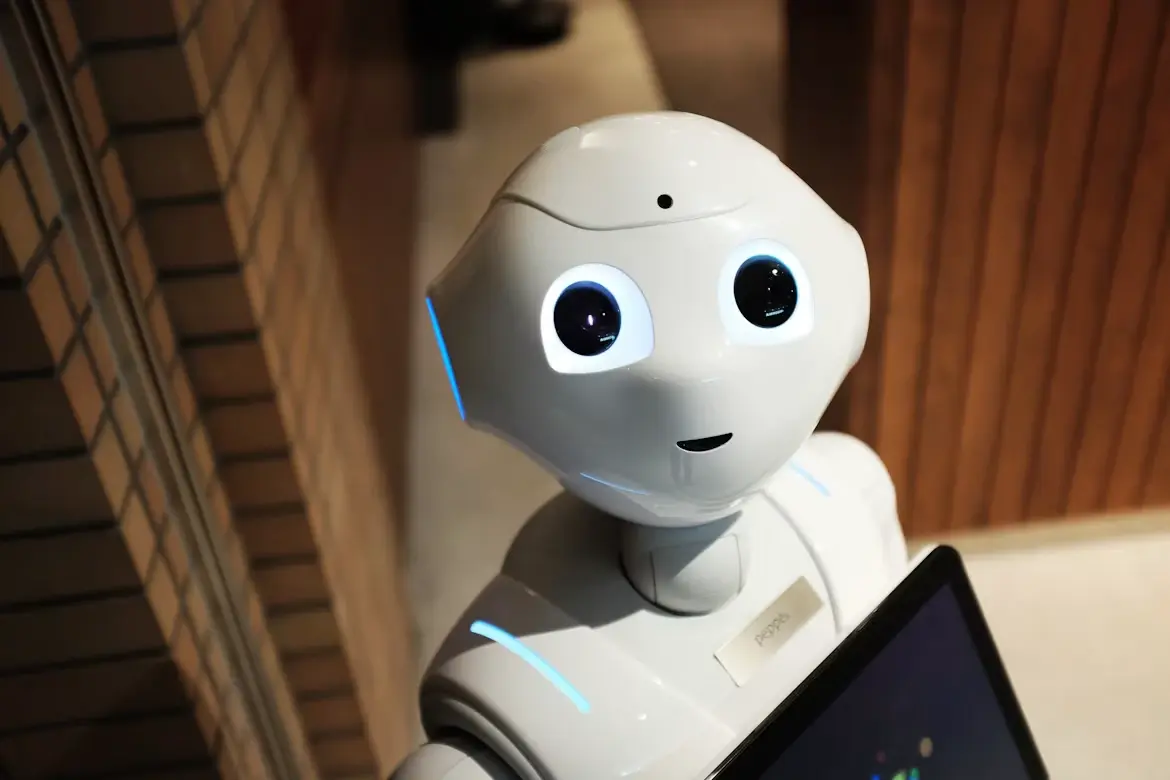
AI is moving beyond screens into the physical world. While LLMs process text, embodied AI relies on robotics data to help robots perceive and interact with real environments.
From camera images to physical interaction feedback, different types of robotics data help autonomous systems understand how the world works. However, collecting reliable robotics training data is complex. Robots must learn from physical environments such as Hong Kong’s high-density urban landscapes, high-traffic transit hubs, and [1] interconnected property ecosystems. Where unexpected obstacles create additional challenges. Understanding robotics data collection, simulation techniques and data infrastructure is therefore essential for businesses developing autonomous systems.
Robotics Data: Turning Digital AI Into Physical, Embodied Systems
Robotics data refers to information collected from a robot's sensors, internal systems and interactions with its surroundings. It allows AI models to understand physical conditions, track movements and learn how actions affect the environment.
Unlike conventional AI datasets, robotics data must capture how events unfold over time. A vision-language model[2] [KC3] can analyse an image of a moving object, but a robot needs to determine where that object is, how quickly it is moving and whether taking action would create a collision risk.
Three information layers are particularly important:
Spatial perception: Camera images, depth measurements and 3D maps help robots identify objects, distances and obstacles.
Temporal telemetry: Timestamped records capture changes in position, speed, motor performance and system status. This robotics telemetry data helps engineers reconstruct robot behaviour.
Physical interaction feedback: Force measurements and contact sensors reveal how robots interact with objects and respond to resistance.
Together, these inputs support perception, decision-making and physical control.
Key Distinction: Digital AI Data vs. Embodied AI Data Architecture
Dimension | Digital AI Data | Embodied AI Data |
Data modality | Primarily text, images, audio and video | Multimodal sensor readings, spatial measurements, motor states and actions |
Temporal synchronisation | Depends on the task; often works with independent inputs | Requires aligned sensor readings and action sequences |
Feedback loops | Model evaluation, user feedback and preference signals | Continuous perception-action feedback, including physical outcomes |
Physical safety boundaries | Primarily information and software-related risks | Collision prevention, mechanical limits, operational safety and environmental risks |
The central difference is that embodied AI must connect intelligence with physical consequences. Robotics training data needs to describe not only what a robot observes, but also what happens when it acts.
Robotics Sensor Data: Types and Multimodal Inputs
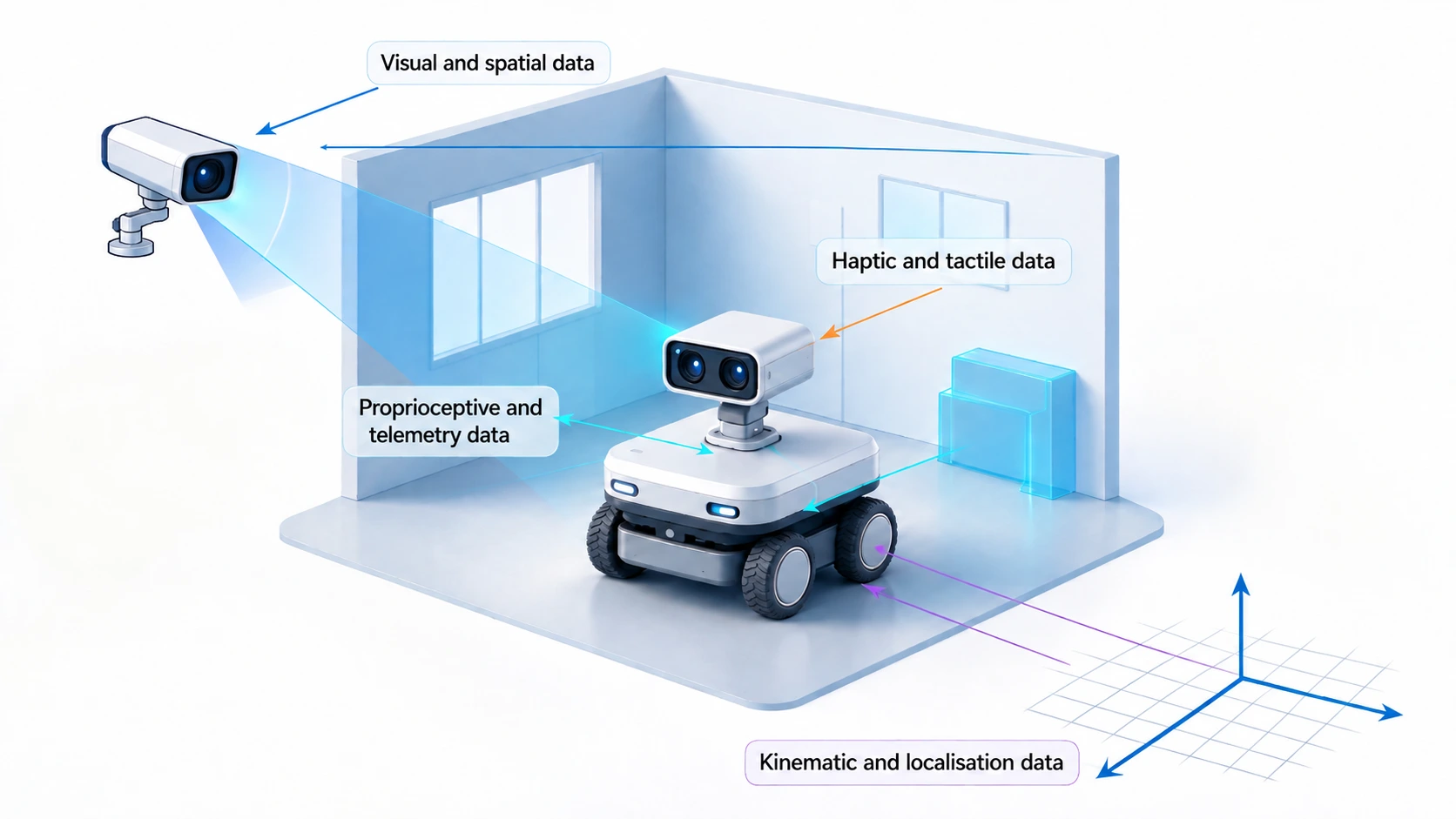
Robots use multiple sensors because no single measurement can fully describe a physical environment. Four common types of robotics sensor data include:
Visual and spatial data: RGB cameras, RGB-D depth cameras, stereo vision and LiDAR sensors capture visual surroundings and three-dimensional structures. They support object detection, obstacle avoidance and environmental mapping.
Proprioceptive and telemetry data: Inertial measurement units (IMUs), motor encoders, electrical sensors and temperature monitors track internal motion and operating conditions. Robotics telemetry data logging helps engineers assess movement accuracy and mechanical performance.
Haptic and tactile data: Tactile sensor arrays and six-axis force-torque sensors measure physical contact. These signals help robotic arms grip delicate objects, regulate pressure and perform precise manipulation.
Position, ranging and localisation data[4] [KC5] : RTK-GPS, ultra-wideband (UWB) positioning and ultrasonic sensors determine absolute and relative spatial coordinates, movement vectors and distance. These measurements provide the foundational data required for autonomous navigation and localisation, feeding into algorithms that compute derived kinematic states (such as instantaneous velocity and acceleration).
Note: Categorised by functional use case for clarity. Under formal robotics taxonomy, these domains frequently intersect—for example, kinematic measurements represent a foundational subset of proprioceptive telemetry. [6] [7] |
High-Bandwidth Sensor Data Architecture
Which sensors produce the most data in robotics? Cameras and high-resolution LiDAR systems can generate particularly large data volumes. The following specifications illustrate how robotics sensor data rates vary across devices.
Sensor type | Example output rate or sampling frequency | Typical deployment | Storage overhead |
RGB-D camera | RealSense D435: RGB 30 FPS; depth up to 90 FPS | Object recognition, depth perception | High |
3D LiDAR | Ouster OS1: up to 20 Hz and 5.2 million points/second | Navigation, mapping, obstacle detection | Very high |
IMU | Bosch BMI270: accelerometer 12.5–1,600 Hz; gyroscope 25–6,400 Hz | Motion estimation, stabilisation | Low per sensor |
Force-torque sensor | Robotiq FT 300: 100 Hz | Robotic gripping and manipulation | Low |
RTK-GPS | u-blox ZED-F9P-02B: up to 20 Hz RTK positioning, depending on configuration | Outdoor localisation | Low |
Sources: RealSense D435, Ouster OS1, Bosch BMI270, Robotiq FT 300 and u-blox ZED-F9P-02B.[8] [9] [10] Figures represent device-specific capabilities, not universal operating rates. Storage classifications are qualitative.
High-bandwidth sensors make efficient robotics data infrastructure increasingly important. Without selective recording and compression, a large robot fleet can create substantial storage and network demands.
Real-World Robotics Data Collection Methods and Operational Bottlenecks
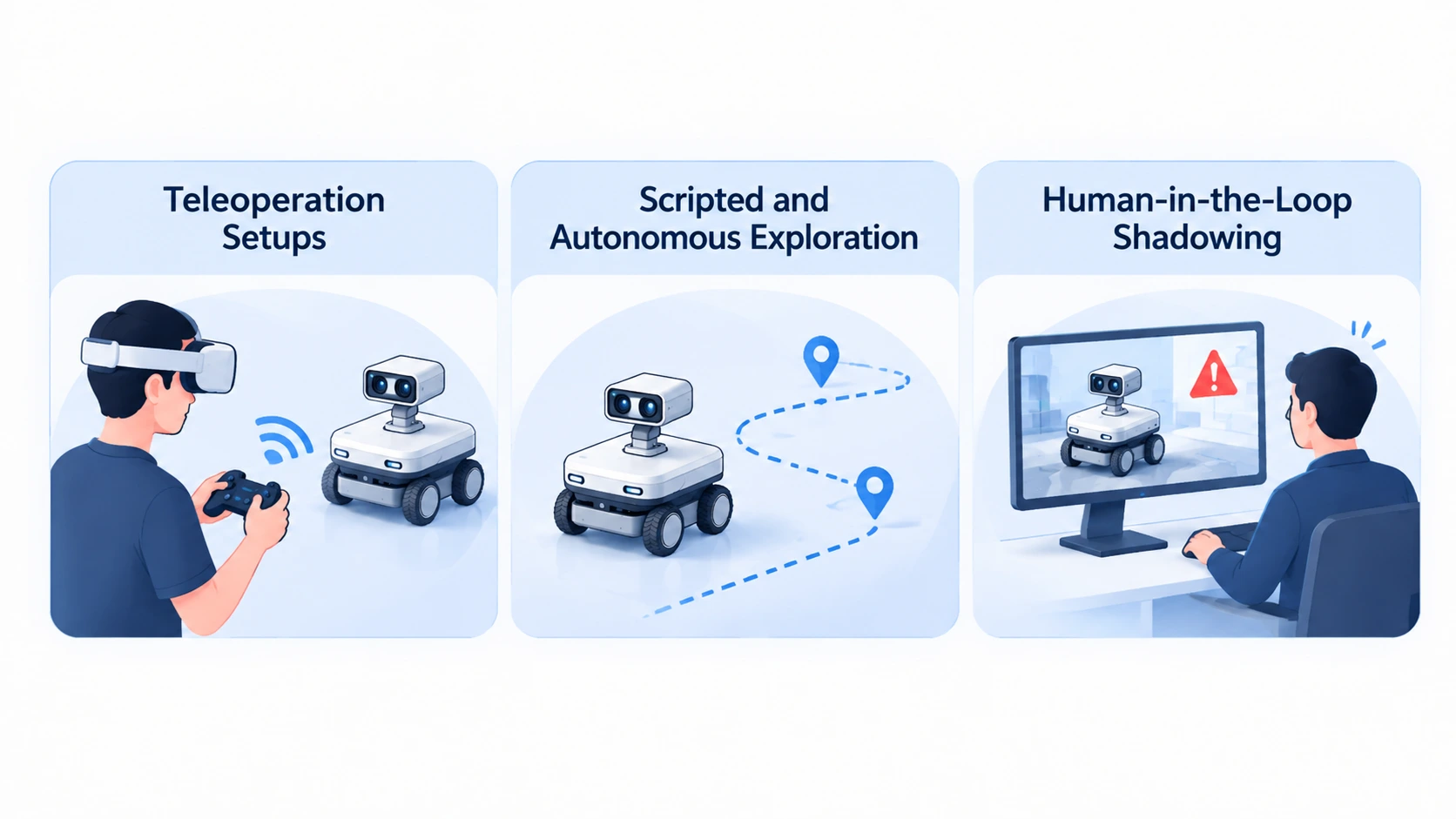
Real-world robotics data collection provides the observations needed to train, test and refine autonomous behaviour. For businesses exploring how to collect robot sensor data, three collection methods are particularly relevant.
Teleoperation setups
Engineers or trained operators control robots using VR headsets, remote controllers or master-slave robotic systems. These teleoperation setups record human-guided actions alongside camera feeds, joint movements and force measurements.Scripted and autonomous exploration
Robots follow predefined movement sequences or perform controlled autonomous actions while sensors record operating conditions.Human-in-the-loop shadowing
Operators monitor robot behaviour and intervene when necessary. These interventions help capture difficult situations, unexpected obstacles and system failures.
Major Bottlenecks in Physical Data Acquisition
Despite improvements in automation, collecting real-world robot data remains challenging:
Hardware and labour costs: Physical robots require equipment, maintenance, trained operators and suitable testing environments.
Safety risks: Capturing collisions, failed grasps and unusual operating conditions can damage equipment or endanger people.
Privacy and regulatory requirements: Cameras and location sensors may capture individuals or sensitive operational information.
Complex data annotation: Sensor measurements must be synchronised with actions, locations and outcomes to produce meaningful training examples.
Synthetic vs Simulated vs Real Data: Solving the Sim2Real Gap for Robots
Simulation-to-reality, commonly called Sim2Real[11] [12] , describes the process of transferring robot behaviour developed in a virtual environment into a physical robot. Simulation allows developers to repeat tasks, test unusual conditions and train models without exposing hardware to every possible failure. Yet virtual environments cannot perfectly reproduce real-world dynamics. This difference is known as the Sim2Real gap. [1]
Two related approaches help address the problem:
Physics-based simulation: Models how robots and objects move and interact, including forces, gravity and collisions. It is particularly useful for motion planning and control. [2]
Synthetic data generation: Creates artificial sensor observations, such as rendered camera images, depth maps and labelled objects. It is useful for perception training. [1]
Real vs. Simulated vs. Synthetic Robotics Data
Dimension | Real-world data | Physics-based simulated[13] [KC14] data | Synthetic sensor data |
Generation cost | High when hardware and labour are required | Lower marginal collection cost after setup | Lower marginal generation cost after setup |
Physical fidelity | Captures actual physical behaviour | Depends on simulation accuracy | Depends on underlying simulation and rendering |
Visual diversity | Limited by available environments | Depends on visual simulation capabilities | Can generate extensive visual variations |
Scalability | Constrained by physical testing capacity | Supports repeated and parallel testing | Supports automated dataset generation |
Sim2Real transfer risk | Lower environmental mismatch for the tested setting | Risk from inaccurate physical modelling | Risk from unrealistic visual or sensor properties |
Overcoming the Sim2Real Domain Shift
Developers use several techniques to improve the transfer of learned behaviour:
Domain randomisation: Vary lighting, textures, object placement, friction and other conditions during training. [1]
System identification: Measure real-world mechanical behaviour and use those measurements to improve simulation accuracy. [3]
Systematic perturbation: Introduce controlled disturbances or sensor noise to test how reliably a robot responds. [4]
Hybrid fine-tuning: Use real-world observations to refine models initially trained with simulated or synthetic data. [5]
Enterprise Robotics Data Infrastructure: Telemetry Pipelines, Security and Governance
As robotics deployments expand, managing data across multiple machines becomes an operational challenge. An effective enterprise architecture generally involves four stages:
Edge logging and filtering
Sensors and onboard processors capture relevant information directly on the robot. Initial filtering removes unnecessary data, while critical events and safety signals are prioritised.Telemetry pipelines and automation
Data is timestamped, synchronised and organised into structured records. Tools such as ROS 2 rosbag2 support recording and replaying robotic system messages.
Automated workflows can identify abnormal conditions and prepare useful records for analysis.Cloud storage and fleet analytics
Selected recordings are transferred to central infrastructure, where engineering teams analyse robot performance across deployment sites. Fleet analytics can reveal repeated failures, maintenance needs and differences between operating environments.Data governance and compliance
Enterprises need appropriate access controls, encryption, retention policies and data quality procedures.
Where robotics systems collect personal or sensitive information, data handling must also reflect applicable privacy and regulatory requirements.
Commercialising Embodied AI: Strategic CVC Scaling with MTR Lab
Developing a capable AI model is only one part of building a commercially viable robotics business. When it comes to investment, embodied AI would require investors to look at all the dimensions that exist otherwise with other types of AI investments, including algorithm, speed of iteration, vertical expertise and so on. But on top of these, it also requires something else:
First of all, embodied AI ultimately is still hardware. It needs to be manufactured, repetitively, in a factory. It will probably have more SKUs than iPhones probably; it will require a large number of parts, and there will be very long supply chains. So, can the company handle this either in-house or through outsourcing? Can they also manage costs very well?
Secondly, embodied AI physically interacts with our lives. It may break things, and even people may get hurt. So, safety, reliability and responsibility will be concerns. Compared to software-based AI, embodied AI companies will have more trade-offs to make in technology, in costs and in ethics. Regulations could also be a hurdle for these companies to succeed.
Finally, it would take longer for the market, for consumers, to start using embodied AI than using ChatGPT. So, for many startups in embodied AI, it could be a longer path to commercialisation and to profitability. So, cash runway and the company’s ability to fundraise is also important.
According to research released by Deloitte at the China International Import Expo, the global market for embodied AI surpassed $21 billion in 2025 and is expected to scale beyond $100 billion by 2030. The industry landscape for embodied AI eventually could be as consolidated as the automotive industry today. It requires capex, after-sales networks and data from robots that have already been sold to train your next-generation robots. So, big players and early players will have advantages.
These considerations are particularly relevant to corporate venture capital (CVC), where strategic investors can contribute industry knowledge, commercial relationships and opportunities to validate technologies in realistic operating environments.
At MTR Lab, we see opportunities across the AI value chain, from foundational technologies and infrastructure to application and workflow layers. In the field of embodied AI, where real-world validation, physical safety, and long-term capital are essential, we offer builders more than just funding. By connecting startups with the real-world opportunities they need to expand, MTR Lab remains committed to supporting pioneers shaping the next phase of technological development. We will continue to focus on both technologies that can be applied today to solve real-life problems and frontier technologies that can reshape the world and industries tomorrow.
Read MTR Lab's investment portfolio
Real-World Sandboxes: Deploying AI in Transportation, PropTech and Smart Cities
Robotics data sets for machine learning become particularly valuable when they reflect the conditions systems will encounter after deployment.
Potential urban testing environments include railway and station operational automation, smart building management, property operations, pedestrian flux analytics, and smart retail environments. These environments can expose robotics developers to practical constraints that are difficult to reproduce fully in laboratories.
As an investor actively focused on mobility, property technology and smart-city innovation investment, MTR Lab offers relevant strategic capabilities for evaluating such applications.
Potential Portfolio Synergies: Digital Twins and Vision-Language AI
MTR Lab brings unique strategic value by backing data-driven and AI pioneers. Through investments in digital twins like isBIM and vision-language AI platforms like Whale, MTR Lab helps companies scale their R&D, fueling a product leap into a sustainable competitive advantage.
isBIM develops Building Information Modelling (BIM), digital twin and AI-enabled solutions for construction management. Digital twins provide structured spatial and operational representations of physical environments. Paired with calibrated physics models and simulation engines, these virtual replicas create high-fidelity environments to validate construction sequences, robotic workflows and end-to-end operational processes.
Whale develops enterprise AI solutions incorporating vision-language capabilities, IoT and data infrastructure. Vision-language AI can connect visual observations with semantic understanding, helping systems interpret objects, activities and environmental context. These capabilities are relevant to broader research into intelligent machine perception.
Building the Data Foundation for Embodied AI
Robotics data is becoming an important foundation for autonomous systems and physical AI. To build reliable real-world applications, engineering teams must evaluate every key type of robotics data—from raw sensor feeds like LiDAR and computer vision to proprioceptive telemetry and spatial coordinates. Establishing robust pipelines for robotics data collection is critical to capturing corner cases, dynamic environmental interactions, and safe operational parameters. Ultimately, transforming these high-fidelity inputs into production-grade robotics training data ensures models generalize effectively from simulation to reality, translating pure technical performance into safe operations and sustainable commercial value.
MTR Lab supports technology businesses developing solutions relevant to mobility, smart cities and other urban industries. Companies building innovative AI and robotics technologies can explore potential investment and collaboration opportunities through MTR Lab's Submit Pitch page.
Frequently Asked Questions (FAQ)
What is the primary operational difference between simulated data and synthetic data in robotics?
Simulated data focuses on physical interactions and movement dynamics within a virtual environment, while synthetic data generates artificial sensory inputs like images and depth maps to train perception models. In practice, modern physics simulators often create synthetic sensor feeds at the same time, allowing teams to use both to train and test embodied AI systems.
How do enterprise robotics startups overcome the high storage and bandwidth costs of telemetry logging?
Startups manage telemetry costs by processing data directly on the robot, uploading only high-value events rather than streaming continuous raw footage. By using local buffers that trigger uploads during errors or safety anomalies—combined with compact file formats and tiered cloud storage—teams keep infrastructure costs low while retaining essential diagnostic data.
Reference:
Muratore, F., Ramos, F., Turk, G., Yu, W., Gienger, M., & Peters, J. (2022). Robot Learning from Randomized Simulations: A Review.
Heiden, E., et al. (2020). Augmenting Differentiable Simulators with Neural Networks to Enable Fast System Identification.
OpenAI / ICRA (2024). ASID: Active Exploration for System Identification in Robotic Manipulation.
Genie Sim 3.0 (2026). A High-Fidelity Comprehensive Simulation Platform for Humanoid Robot.
Claru (2026). Sim-to-Real Transfer Data Collection.
Intel / Red Hat (2026). Physical AI Platform: Sim-to-Real Transfer.
Kaspar, M., et al. (2020). Reinforcement Learning with Cartesian Commands and Dynamics Randomization for Sim2Real Transfer.
Murphy, K., et al. (2021). Sim2Real for Soft Robotic Fish via Differentiable Simulation.