
The China AI ecosystem is entering a new phase. Industry leaders within the AI ecosystem in China are exploring how foundation models perform in enterprise deployment and whether China's domestic momentum can be converted into international growth.
China has built a strong foundation for AI development. Yet developing competitive technology and building a successful global business are two different challenges. For Chinese AI companies looking overseas, commercial testing and market access matter as much as technical capabilities.
What forces have served as the primary China AI ecosystem driver behind this evolution, and what structural factors will dictate its next stage of growth?
The Macro Landscape of China's Hyper-Scaling AI Ecosystem
China's AI sector has grown from a market focused largely on research and technology development into a broader ecosystem of model developers, infrastructure providers, enterprise software companies and investors. This open-source AI models ecosystem in China is driven by leading tech giants and specialized labs—such as DeepSeek, Alibaba (Qwen), and Moonshot AI (Kimi)—that rapidly release frontier, open-weight models excelling in reasoning, coding, and multimodal tasks.
According to the China Academy of Information and Communications Technology (CAICT), China's AI market size exceeded RMB 1.2 trillion in 2025, representing an estimated 40% year-on-year growth rate. By June 2026, China had more than 6,600 AI companies, accounting for approximately 15% of the global total.
Beyond its current market size, AI also presents considerable opportunities for economic value creation. A recent forecast from a research institute affiliated with China’s Ministry of Industry and Information Technology projects that the market size of core industries for the smart economy will reach RMB 12.6 trillion by 2030, accounting for 25.1% of the country’s digital economy revenue.
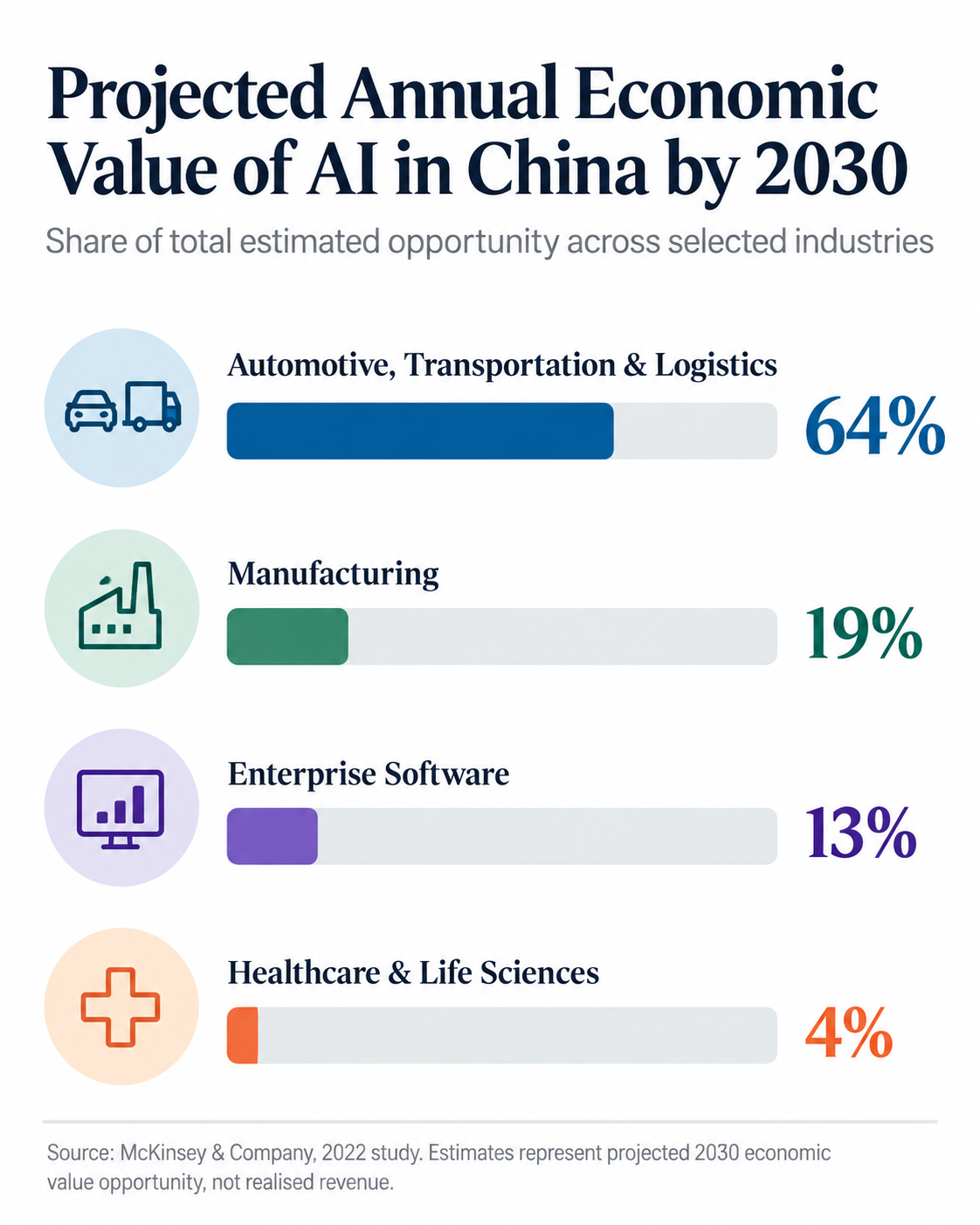
Behind these figures is a market that has become more diverse. Major technology companies such as Alibaba, Baidu, Tencent and Huawei continue to invest in AI research, cloud computing and infrastructure. Meanwhile, a vibrant cohort of pure-play foundation model startups like DeepSeek, Moonshot AI and Zhipu AI has fueled China’s open-source AI wave, releasing state-of-the-art models that have achieved performance parity with top global benchmarks. At the same time, specialist firms deploy AI across cybersecurity, robotics, industrial automation and enterprise software, enabling enterprise-grade scaling in more sectors.
A defining pillar of the ecosystem’s hyper-scaling dynamic is its concentrated regional innovation clusters. Beijing’s Haidian District, anchored by Zhongguancun Science City, stands as the core AI hub of the Chinese Mainland, hosting over 1,900 AI enterprises including 26 unicorns as of December 2025. Through strategic collaboration with MTR Lab, the district’s innovation community is amplifying its commercial impact and strengthening the collaboration across China's AI ecosystem.
The collaborative flywheel connecting model developers, compute operators, and application layers serves as the primary engine for China AI ecosystem development. Foundation models supply the core technological base, cloud platforms lower the barrier to access via API and hosted services, and application developers adapt it to specific business needs. Enterprise customers then supply feedback, powering fast cycles of commercial iteration.
Core AI Ecosystem in China Drivers
A confluence of structural advantages has expanded China's artificial intelligence capabilities, converting raw research breakthroughs into production-grade systems.
Engineering Density and Talent Pool: China's universities, research institutions and technology companies have developed a substantial base of AI researchers and engineers. This concentration of expertise supports work in machine learning, model optimisation and practical applications.
High-Frequency Data Production: China's large digital economy generates data through e-commerce, digital payments, manufacturing and online services. This creates opportunities to develop and test AI applications across different scenarios.
Rapid Commercial Iteration Cycles: A sizable domestic market gives developers opportunities to test products with different users and businesses. Feedback from these deployments can help teams identify problems, refine features and improve performance.
Technology Giant Synergies: Companies such as Alibaba, Tencent, Baidu and Huawei contribute cloud infrastructure, development platforms, technical resources and investment. Their ecosystems can help smaller developers bring products to market. Targeted policy frameworks, municipal computing vouchers, and public-private co-investments de-risk early R&D, allowing scale-ups to direct capital toward commercial product-market fit.
Taken together, these factors help explain the pace of China's AI ecosystem development. Research expertise makes innovation possible, while enterprise demand and access to infrastructure create opportunities to put that innovation to work.
Infrastructure Acceleration: Open-Source Models and Enterprise Compute Density
One of the most notable developments in China's AI market has been the growing availability of advanced models that businesses can adapt for their own needs.
Alibaba's Qwen series, for example, has made capable AI models more accessible to developers and enterprise users. In August 2026, Alibaba Cloud reported that the Qwen ecosystem had recorded more than three billion global downloads and over 300,000 derivative models across Hugging Face and Alibaba Cloud Model Studio.
This kind of model availability can lower development barriers, particularly for smaller companies with limited research budgets. Depending on the model and its licensing terms, businesses can also gain greater control over deployment, customisation and integration with existing systems.
Chinese open-source model developers have drawn growing global market attention. A Gartner forecast projects that 50% of enterprises worldwide will include Chinese-developed large language and multimodal models in their AI portfolios by 2027, representing a tenfold jump from the 5% share registered in 2025. The global adoption of Chinese AI models reflects growing international interest in China's AI ecosystem.
Computing capacity is the other backbone supporting this hyper-scaling adoption. China has invested in data centres, computing clusters and national initiatives such as the East-to-West Computing Resource Transfer project. These efforts optimise the distribution of computing workloads across regions and drive down unit computing costs.
For AI developers, access to reliable computing resources affects how quickly they can train, test and deploy products. For enterprise customers, infrastructure also influences operating costs, system performance and the feasibility of scaling an application. Together, accessible models and expanding computing capacity give more businesses the tools to experiment with AI. The next challenge is turning that experimentation into sustained use.
China AI Ecosystem Global Adoption: The Scaling Ceiling for Mainland AI Scale-Ups
China's domestic market gives AI companies access to customers, technical talent and opportunities for product development. Expanding internationally presents a different set of demands.
A product that performs well in China may still need considerable work before it can meet the expectations of an overseas enterprise customer.
Three challenges are particularly relevant.
The first hurdle is the lack of real-world commercial testing sandboxes in international markets. Businesses want evidence that an AI solution can operate reliably within their systems. A promising demonstration is rarely sufficient to secure a contract, especially in industries where operational reliability is critical.
Building cross-border enterprise networks takes time. Companies entering a new market need to understand local customer expectations, identify suitable partners and establish credibility with decision-makers. Without these relationships, even a technically competitive product may struggle to reach potential buyers.
Traditional venture capital funding carries inherent limitations that constrain international scaling. While financial capital finances product development and payroll, early-stage ventures require strategic corporate investors capable of opening procurement pipelines, supplying commercial sandboxes, and navigating foreign regulatory frameworks.
Comparative Analysis: Domestic Deployment vs. Global Commercial Scaling
Comparison Dimension | Chinese Mainland Domestic Market Context | Global Scaling Requirements | Critical Expansion Bottlenecks |
Sandbox Validation Environments | Familiar business settings and existing customer relationships | Testing in different operational environments and industries | Limited access to overseas pilot projects |
Capital Attributes | Funding for research, product development and domestic expansion | Capital combined with market knowledge and strategic partnerships | Funding without sufficient commercial connections |
Regulatory and Trust Barriers | Established understanding of domestic rules and procurement practices | Compliance with local data protection, cybersecurity and procurement requirements | Additional compliance work and customer trust requirements |
Enterprise Pipeline Access | Domestic business networks and distribution channels | Local partnerships and international enterprise customers | Difficulty establishing new commercial relationships |
The differences highlight why international expansion requires more than a competitive product. Strategic ecosystem partnerships offer one targeted response to these gaps. MTR Lab’s Partnership with Zhongguancun (ZGC) Science City, for example, connects Chinese tech scale-ups with cross-border application access opportunities, compliance guidance and commercial market pathways.
Bridging the Gap: The Strategic Role of Corporate Venture Capital in Supporting Global Expansion
For AI companies seeking international growth, the right investor can be an invaluable partner. Corporate venture capital (CVC) brings together investment and the industry experience of an established business. Four areas are especially relevant to AI scale-ups.
1. Capital Deployment with Strategic Intent
Funding gives startups the resources to develop products and hire talent. Strategic capital adds another consideration: how the technology fits into real business needs.
A corporate investor with relevant industry experience can identify suitable applications, introduce potential partners or help founders better understand enterprise purchasing decisions.
2. Access to Real-World Commercial Sandboxes
An AI system can perform well in controlled testing and still encounter problems in a live business environment.
Through commercial partnerships, technology companies may gain opportunities to conduct Proof-of-Concept (PoC) projects and assess how their products work alongside existing systems. These projects can reveal integration issues, operational limitations and areas for improvement. They also give potential customers a clearer picture of the technology's practical value. For startups, this kind of evidence can be more persuasive than technical specifications alone.
3. Enterprise Compliance and Localisation Acceleration
International expansion often requires changes to how a product is developed, deployed and supported. Data protection rules, cybersecurity expectations and enterprise procurement procedures vary between markets. Products may also need to be adapted to local languages, operating practices or customer requirements.
Corporate investors with international business experience can help startups understand these expectations and connect with relevant local expertise.
4. Global Ecosystem Integration
Finding the right customers and partners is a major part of building a business overseas.
Established corporate networks may introduce AI companies to potential enterprise users, commercial partners and investors. These connections can help founders assess demand, understand market conditions and explore new routes to growth.
For AI scale-ups, the most useful partnerships are often those that connect financial backing with a clear understanding of where the technology can create value. MTR Lab's investment portfolio offers a closer look at the innovative companies it supports and the technologies it considers relevant to real-world business needs.
MTR Lab: The Strategic Gateway and Cross-Border Bridge for AI Scale-Ups
As a CVC, MTR Lab focuses on technology investments in smart cities, and sustainable mobility, pairing strategic capital with real-world infrastructure testbeds opportunity and cross-border commercial pathways to power investment portfolio success beyond Hong Kong.
Hong Kong has an important role in connecting the Chinese Mainland's technology sector with international markets. Its established business networks and cross-border relationships can connect companies with opportunities to reach new customers and develop partnerships outside their domestic market.
For MTR Lab, this bridging role underpins our collaboration with tech firms and innovation partners. We not only source promising technologies, but also identify real-world cases where these technologies can solve business challenges and deliver long-term value.
Two recent case developments exemplify our investment philosophy.
Strategic Ecosystem Synergy: Zhongguancun Science City Ltd. Partnership
In March 2026, MTR Lab announced an ecosystem partnership with ZGC Science City Ltd to explore investment and collaboration opportunities involving Chinese technology startups. The partnership covers emerging technologies including AI, robotics, smart mobility, rail, retail, property and construction, with an emphasis on smart cities and sustainability.
The partnership draws on the complementary strengths from both sides: ZGC Science City Ltd. brings deep access to Beijing’s frontier innovation ecosystem and high-potential mainland ventures, while MTR Lab contributes its cross-border industry networks, commercialisation expertise and market pathways across Hong Kong and international markets.
Many startups have strong engineering capabilities but need access to industry expertise, potential customers and new operating environments. Ecosystem partnerships can help create those connections. This collaboration represents one way MTR Lab is working to connect high‑potential tech startups from the Chinese Mainland with opportunities in Hong Kong and beyond.
Commercialisation Proof Point: B+ Round Co-Investment in Eagle Cloud
In September 2026, MTR Lab co-invested in Eagle Cloud alongside Northern Light Venture Capital, supporting the company’s next phase of growth.
Eagle Cloud focuses on helping enterprises manage digital resources, AI systems and emerging AI agents. As businesses introduce AI agents into everyday operations, they face new questions about system access, permissions and accountability. Organisations need to know what these systems can do, which information they can access and how their activities are governed. Eagle Cloud's technology addresses these concerns through enterprise security and governance capabilities.
MTR Lab’s participation is in line with its strategic investment focus on driving the scalable growth of deep tech companies while emphasising AI infrastructure and security governance capabilities. The capital injection will support Eagle Cloud in further developing its AI governance infrastructure and executing its international expansion plans, including establishing overseas operations, building local deployment capabilities, and scaling its enterprise client base.
Conclusion and Recommendations
The China AI ecosystem is increasingly shaped by the ability to turn technological innovation into sustainable commercial growth. As Chinese AI models gain international attention, companies will need to show that their products can meet overseas customer requirements and deliver value beyond their home market.
Strategic investment can accelerate this transition. Through targeted investments, industry knowledge, established enterprise relationships and ecosystem collaboration, MTR Lab connects technological innovation from the Chinese Mainland to global commercial opportunities.
We welcome technology companies pursuing strategic investment or international expansion to share your proposals with us.
Frequently Asked Questions (FAQ)
What specific AI sub-verticals does MTR Lab prioritise for strategic investment?
MTR Lab connects scale-ups with operational testing opportunities, regulatory de-risking guidance, and international business networks. Through corporate venture post -investment support , portfolio companies the opportunity to validate AI systems inside high-density operational environments (rail operations, smart properties, and urban mobility), align data workflows with international standards and leverage reference case studies to shorten enterprise sales cycles across Hong Kong and global markets.
How does MTR Lab assist Chinese Mainland AI scale-ups in overcoming global compliance and adoption barriers?
MTR Lab works with technology companies through strategic investment, industry knowledge and partnerships across its international ecosystem.
These relationships may help startups access international markets, identify commercial testing opportunities and connect with potential enterprise partners.
While MTR Lab can contribute industry experience and access to relevant networks, individual companies remain responsible for meeting local regulatory requirements and managing their own product deployment.